Hyperliquid fees depend on how each order fills
Hyperliquid fees depend on executed trade value, maker or taker status, and the applicable account and market rates. A submitted order can produce several fills, each contributing to the final charge. Compare execution prices alongside fees, then reconcile the recorded charges with the resulting balance or position. For perpetual trades, funding adds a separate payment or receipt while exposure remains open. An order estimate therefore describes expected costs before execution, rather than a completed account settlement.
Updated -Maker and taker execution on the same cost basis
A useful comparison holds the market, direction, and quantity constant while examining execution price and fees. A maker fill supplies resting liquidity; a taker fill consumes available liquidity. Comparing their fee rates alone leaves out the price at which each trade executes. A resting order may obtain a favorable price, remain unfilled, or execute before the market moves against the resulting position.
Use one price benchmark and one measurement period for both alternatives. The spread describes the gap between buying and selling quotes. Slippage describes an execution difference against a chosen reference price. Neither necessarily appears as a separate account debit. If a calculation already measures execution against the midpoint, adding the spread again can count the same price difference twice.
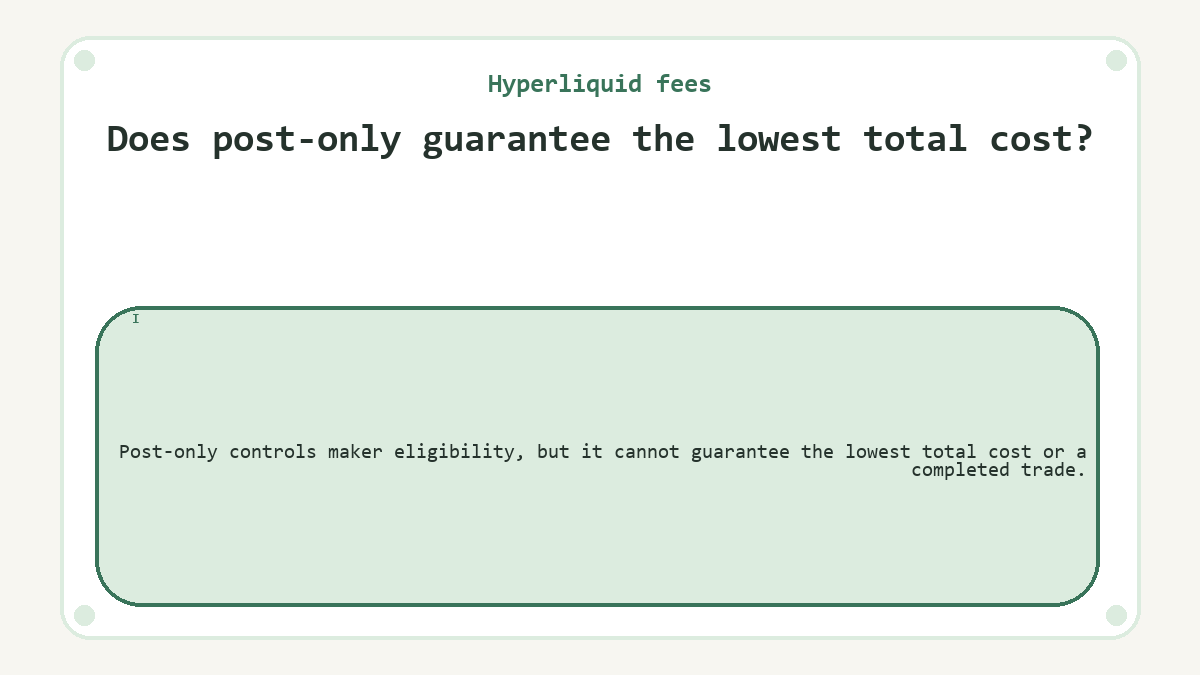
Does post-only guarantee the lowest total cost?
Post-only controls maker eligibility, but it cannot guarantee the lowest total cost or a completed trade.
Resting execution
Hyperliquid's post-only option, also called ALO, cancels an order that would match immediately. An accepted order waits on the book and executes only as resting liquidity. That restriction avoids immediate taker execution, although waiting introduces uncertainty about whether the requested quantity will fill. The fee benefit belongs to completed maker fills, rather than the act of submitting the order.
Immediate execution
An immediate-or-cancel order executes available quantity within its price conditions and cancels the remainder. This exchanges the opportunity to wait for a resting fill for immediate access to available liquidity. The final comparison needs executed quantity as well as price and fees: a partially completed instruction does not provide the same exposure as a fully completed one.
Account rates and market adjustments
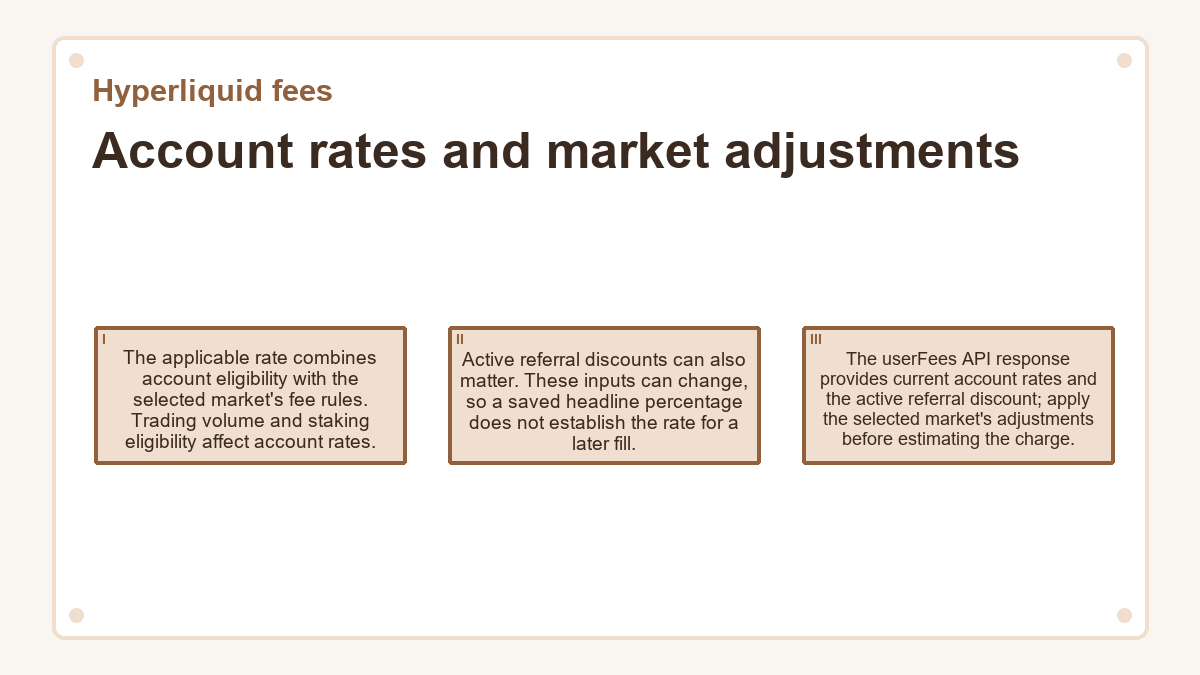
The applicable rate combines account eligibility with the selected market's fee rules. Trading volume and staking eligibility affect account rates. Active referral discounts can also matter. These inputs can change, so a saved headline percentage does not establish the rate for a later fill. The userFees API response provides current account rates and the active referral discount; apply the selected market's adjustments before estimating the charge.
Hyperliquid uses separate fee schedules for spot and perpetual trades. Market adjustments also matter: builder-deployed perpetuals and certain spot pairs can have different fee treatment. A shared account tier therefore does not establish one universal rate across every instrument. Keep the account's applicable rate and the market configuration together when estimating costs.
Calculate charges from executed value
For a proportional trading charge expressed in quote units, multiply each fill's executed notional by its applicable decimal rate. If the recorded fee uses another token, convert the calculated amount to that denomination before comparing it with the record. Notional means trade quantity multiplied by execution price. Add the individual charges after expressing them in compatible units. A mixed maker-and-taker order requires separate calculations for the respective fills. Using the original requested size overstates costs when part of the order never executes; using one estimated price can obscure differences between actual fills.
Do canceled orders still leave trading fees?
Canceling an order's remaining quantity leaves the fees from its earlier executions intact. A cancellation stops further execution of that remainder; it does not reverse completed trades. The order's final status and its fill history therefore answer different questions. A canceled order can still have changed the account's holdings or position. Treat the recorded executed quantity as the basis for its trading charges.
Fill records identify the charged amount
A fill record connects execution price and size with the charged fee and its denomination. Hyperliquid's API exposes fields including
px,
sz,
fee,
feeToken, and
oid. The order identifier connects fills belonging to an instruction; timestamps help distinguish activity across the accounting period.
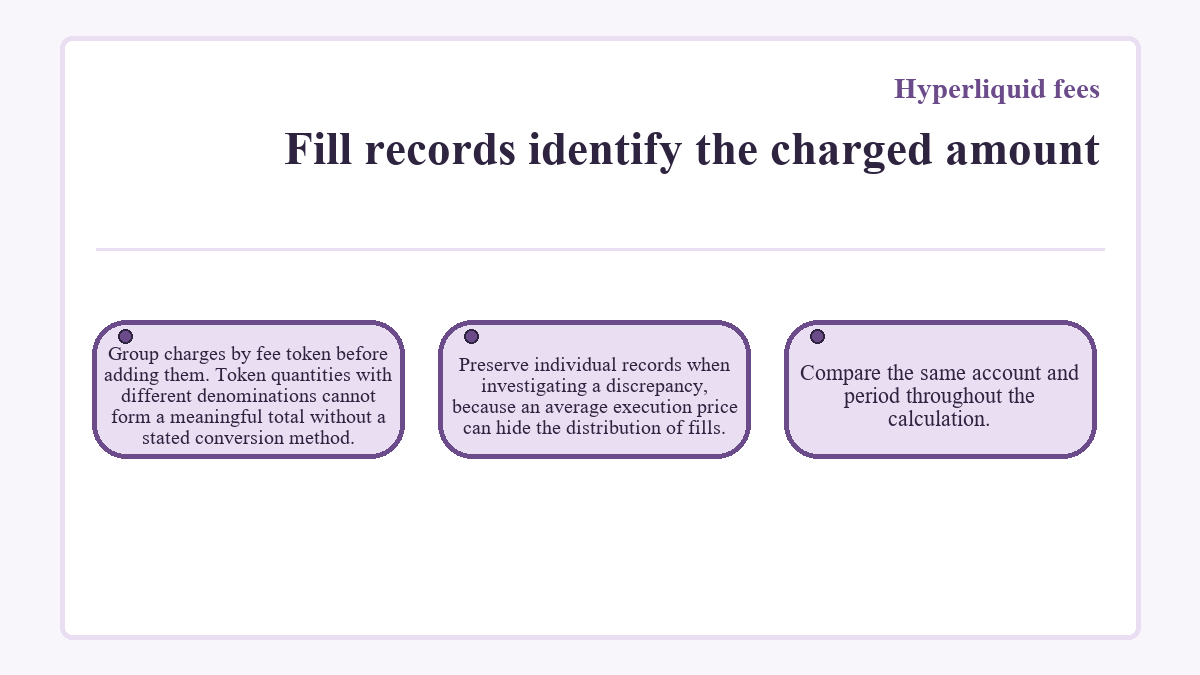
Group charges by fee token before adding them. Token quantities with different denominations cannot form a meaningful total without a stated conversion method. Preserve individual records when investigating a discrepancy, because an average execution price can hide the distribution of fills. Compare the same account and period throughout the calculation.
A mixed-fill order with a reconciled fee total
Consider a hypothetical perpetual entry comparing mixed execution with entirely taker execution. All quantities, rates, execution outcomes, and account conditions in this example are invented inputs. The account starts without a position in the selected contract and has sufficient collateral. Both alternatives use identical fill prices and quantities, isolating the fee difference. Assume no builder charge, funding payment, or unrelated account activity during the comparison.
A trader submits a good-till-canceled limit order. An initial portion executes as taker liquidity, producing 3,165 quote units of notional. The remaining quantity rests and later executes as maker liquidity, producing another 7,835 quote units. Assume effective decimal rates of 0.00043 for taker fills and 0.00018 for maker fills.
The taker portion costs 3,165 × 0.00043 = 1.36095 quote units. The maker portion costs 7,835 × 0.00018 = 1.4103 quote units. Together, the arithmetic produces a charge of 2.77125 quote units before any applicable settlement rounding.
At the same prices and quantities, entirely taker execution would cost 11,000 × 0.00043 = 4.73 quote units. The mixed execution costs 1.95875 fewer quote units under these assumptions. Different execution prices would change that comparison, and a resting remainder that never fills would leave a different position.
In this example, the fills total the submitted quantity, the order has no remaining open quantity, and the position matches those executions. The fee records reconcile to a trading-charge debit of 2.77125 quote units before any applicable settlement rounding. The account still holds the newly opened position. This establishes a completed entry and its execution charge, without establishing a profitable trade or a final holding cost.
Builder charges and permission limits
An application using a builder code can attach an additional fee to eligible orders. The user approves a maximum fee for that builder with the main wallet, not an agent or API wallet. The order specifies the charge within that authorization. Approval establishes a ceiling, rather than a promise that every eligible order will use that amount. Permissions can be revoked.
The fill record's
fee
field includes any reported
builderFee.
Adding both fields together therefore overstates the charge. The separate builder amount explains part of the total. It is useful when comparing applications that submit otherwise equivalent trades.
Funding changes the cost of holding exposure
A perpetual position can generate funding payments after the entry order finishes executing. Funding transfers value between long and short positions. Positive funding means longs pay shorts; negative funding reverses that direction. The rate changes, so multiplying an entry-time rate across an entire holding period produces an estimate rather than a settled total.
Recorded funding payments show what the account actually paid or received over the relevant intervals. Keep them separate from execution fees before calculating the combined result. A funding receipt offsets other costs arithmetically, but it does not establish profitability after price movement. Likewise, a completed entry with no remaining order can continue accumulating funding exposure.
Reconcile the balance before closing the cost calculation
The accounting boundary determines which balance changes belong to the trade being measured. An entry-only calculation ends after entry execution. A completed position calculation includes closing fills and the intervening funding payments. Deposits, withdrawals, and transfers require their own ledger entries when they fall within the same period.
Separate margin from charges
Margin supports a perpetual position and affects the amount available for other actions. A reduction in available balance can therefore exceed the trading fee without indicating an additional charge. Position valuation also changes with market prices. Compare the relevant balance and margin fields consistently, rather than interpreting every reduction in available funds as a fee.
Account for the closing fills
Closing a position creates further executions with their own prices and fee treatment. The exit need not have the same notional value or rate as the entry. Profit-and-loss displays may already incorporate particular charges, so subtracting fees again can distort the result. Reconcile trades and account balances with the display's accounting definition before combining totals. Once the closing quantity matches the remaining position, the account should show no exposure in that contract.
Hyperliquid fees: frequently asked questions
Does increasing leverage multiply the fee rate?
Increasing leverage does not itself multiply the trading fee rate. Fees follow executed notional and the applicable rate, while leverage changes the collateral needed to support exposure. If a leverage change accompanies a larger trade, the larger notional increases the charge even when the percentage stays unchanged.
Can separate subaccounts qualify for different volume tiers?
Hyperliquid combines subaccount volume with the master account's volume, and those subaccounts share its fee tier. Vault volume receives separate treatment. Keep this distinction when comparing accounts: separate trading records do not necessarily mean separate volume-tier calculations.
When does a maker fill receive a rebate?
A maker fill receives a rebate when its applicable maker rate is negative. Resting execution alone does not establish rebate eligibility; the account and market rules determine the rate. A rebate is a credit associated with the fill and should reduce net execution charges.
Is a referral fee discount permanent?
No. Referral fee discounts end when the account reaches the eligible cumulative trading-volume limit. The account's active discount determines whether it applies to an eligible trade. A referral relationship can remain recorded after the conditions for discounted trading no longer hold.
Which price determines a perpetual funding payment?
Hyperliquid calculates funding notional using position size and the oracle price, rather than the mark price. The funding rate for the interval then determines the payment amount. A calculation using a displayed position valuation can differ if that valuation uses another price.
Will splitting an order with TWAP guarantee lower fees?
Splitting an order with TWAP does not guarantee lower fees. TWAP submits smaller orders over time, and each completed execution contributes its own charge. Changing liquidity and execution prices also affect the total cost, while incomplete suborders can leave the intended quantity unfinished.
How can an exported fill history understate total charges?
An exported history can understate charges when it omits part of the relevant period. API fill queries have response and history limits, so one response need not contain every execution. Overlapping downloads create the opposite problem if the same fills enter the total more than once.
Do builder fees apply equally to spot purchases and perpetual trades?
Builder fees have different applicability across those trades. They apply to eligible fees collected in the quote or collateral asset, including both sides of perpetual trading. They do not apply to the buying side of spot trades under that rule. Ordinary trading fees remain a separate consideration.